Who created the whisky flavour wheel?
It was devised in 1979 by Jim Swan and Sheila Burtles at Pentlands Scotch Whisky Research, working with the master blenders Paul Rickards of Robertson and Baxter and George Shortreed of Justerini and Brooks.
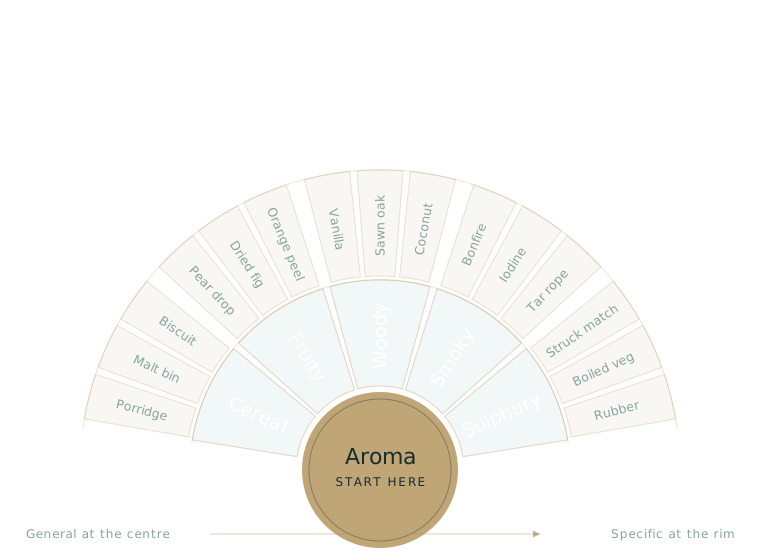
The wheel came out of a collaboration between the sensory scientists at Pentlands, among them Sheila Burtles, who had worked on sensory evaluation at Inveresk and led the sensory side of this, and two master blenders: Paul Rickards of Robertson and Baxter, and George Shortreed of Justerini and Brooks. Between them those two houses accounted for the majority of the blended whisky made in Scotland, so the vocabulary was being agreed by the people who had most to lose from getting it wrong.
It went out to the member companies, which gave them one language for describing what they were tasting. A blender in one firm could put a word to something in a parcel of whisky and know that a colleague in another firm would take it to mean the same thing. That covered faults as much as the characters anyone wanted, since a fault has to be named before it can be traced. It would be almost twenty years before flavour wheels aimed at the drinker appeared, and by the mid-1990s he was teaching that vocabulary directly, at some of the first whisky schools run by the Scotch Malt Whisky Society.
The laboratory side of it was chromatography. Pentlands could separate a whisky into its individual compounds and put a trained nose at the outlet of the instrument, so that a descriptor on the wheel could be tied to something measurable rather than resting on opinion alone.
Flavour scientists in beer and wine were building their own first wheels around the same time, and the whisky one drew directly on that work, adapting a beer flavour terminology published the same year by Meilgaard, Dalgliesh and Clapperton. Three industries were arriving at the same idea together.
The wheel arranges its descriptors in rings, running from broad classes at the centre to specific terms at the rim, so that a taster can start general and work outward. A separate paper, on the descriptive sensory analysis of Scotch whisky flavour, was published in 1981.
The book follows the committee that agreed the vocabulary, and the argument about giving it away.
Subjects
Short factual pages on the things people arrive here looking for.
Last reviewed 3 August 2026